
Attic Insulation Cost and Energy Savings in 2026
Uncover how attic insulation cost and energy savings can add up. See average prices, payback periods, and why air sealing is critical.
By Scott Thompson
Learn more about Insulation Installation or Upgrade for guides, costs, and what to expect.
Compare Insulation Installation or Upgrade Pros Near You

Enter your ZIP code to compare top-rated local professionals and request free quotes.
If your energy bills climb every winter and your upstairs rooms feel like iceboxes no matter how high you set the thermostat, your attic is likely the culprit. Heat rises, and in a poorly insulated home, a massive percentage of that heat escapes through the roof. This is exactly why understanding attic insulation cost and energy savings is one of the most impactful financial decisions a homeowner can make. Unlike a kitchen remodel or a new deck, insulation pays for itself quietly, month after month, through reduced utility bills. It is not the most glamorous home project, but it offers one of the best returns on investment available in the entire home improvement industry.
Before you dismiss this as a minor upgrade, consider the long-term numbers. The U.S. Department of Energy estimates that homeowners can save an average of 15 percent on heating and cooling costs by adding insulation in attics, crawl spaces, and basement rim joists. In older homes with little to no existing insulation, those savings can be even higher. This article breaks down the real costs, the factors that influence pricing, and the concrete savings you can expect. We will also explore the different materials, the importance of air sealing, and how to maximize your return on investment without overpaying for the job.
Average Attic Insulation Cost Breakdown
The cost of insulating an attic is not a single, fixed number. It varies widely based on your location, the size of your attic, the material you choose, and whether you hire a professional or tackle the job yourself. On a national average, homeowners pay between $1,500 and $3,500 for a professional attic insulation installation. This price typically includes labor, material, and the removal of old, damaged insulation if necessary. For a more precise estimate, you can expect to pay roughly $1.50 to $3.50 per square foot of attic space, with the final figure heavily dependent on the R-value you need to achieve.
To give you a clearer picture, here is a quick breakdown of average costs by project size. These figures represent total project costs for blown-in fiberglass insulation installed by a professional, including labor and basic prep work.
- Small attic (under 500 sq ft): $1,000 to $1,800
- Medium attic (500 to 1,000 sq ft): $1,500 to $2,800
- Large attic (over 1,000 sq ft): $2,500 to $4,500 or more
Keep in mind that these are national averages. A homeowner in a cold climate like Minnesota will likely need a higher R-value than someone in Florida, which directly increases material costs. Similarly, labor rates in metropolitan areas are almost always higher than in rural regions. The condition of your attic also matters. If there is existing insulation that contains mold, rodent droppings, or asbestos, the removal cost will add a significant amount to your final bill, often $500 to $1,500 for the extra labor and disposal fees.
Material Options and Their Price Points
Choosing the right insulation material is about balancing upfront cost, thermal performance (R-value per inch), and your specific attic conditions. Each type has its advantages, and the best choice often comes down to your budget and whether you are dealing with an open attic floor or tight spaces between joists. Here are the most common options available to homeowners today.
Blown-In Fiberglass and Cellulose
Blown-in insulation is the most popular choice for attic retrofits. It comes in loose-fill form and is pneumatically blown into place using a hose. Fiberglass and cellulose are the two primary types. Fiberglass is made from spun glass and is naturally non-combustible and resistant to moisture. Cellulose is made from recycled paper products, typically treated with borates for fire and pest resistance. Both materials are excellent at filling irregular spaces and covering existing insulation. The cost for blown-in insulation ranges from $1.00 to $2.20 per square foot for materials and installation. Cellulose generally costs slightly more than fiberglass but offers a higher R-value per inch, meaning you can achieve the same thermal performance with a thinner layer.
Fiberglass Batts and Rolls
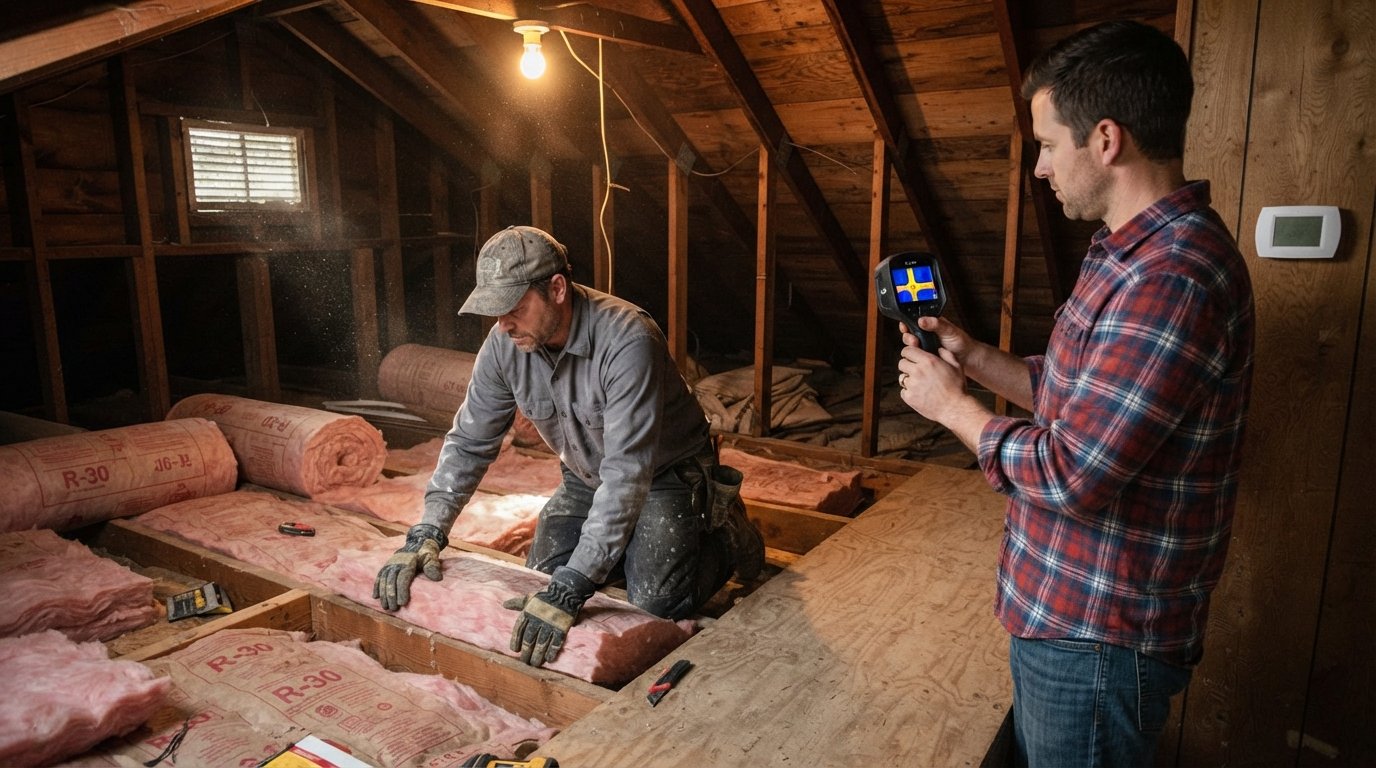
Batts and rolls are the traditional pink or yellow blankets of insulation. They are pre-cut to fit standard spacing between attic joists, which makes them a good choice for DIYers. The material itself is inexpensive, often costing between $0.50 and $1.50 per square foot. However, installing batts correctly requires meticulous attention to detail. You must cut them precisely to fit, avoid compressing them, and ensure there are no gaps. If you are not careful, you can easily leave voids that allow heat to escape, reducing the effectiveness of the entire installation. For this reason, many homeowners prefer to hire a professional even for batt installation, which brings the total cost up to the $1.50 to $2.50 per square foot range.
Spray Foam Insulation
Spray foam is the premium option and provides the highest R-value per inch of any common insulation material. It also acts as an excellent air barrier, sealing cracks and gaps while it insulates. There are two types: open-cell and closed-cell. Open-cell foam is softer and cheaper, while closed-cell foam is denser, stronger, and has a higher R-value. Spray foam is significantly more expensive, ranging from $2.00 to $4.50 per square foot for open-cell and $3.50 to $6.00 per square foot for closed-cell. This price premium is often worth it for attics with complex shapes, ductwork, or significant air leakage issues. By combining insulation and air sealing in one step, spray foam can deliver superior energy savings and improve the structural integrity of your roof.
Why Air Sealing Matters More Than You Think
Adding insulation to an attic that still has massive air leaks is like putting a winter coat on over a torn shirt. The insulation will slow down heat transfer, but if conditioned air is literally blowing out of gaps and cracks into the attic, you are wasting energy. Air leaks are commonly found around recessed lighting fixtures, plumbing vents, electrical wires, and the top plates of interior walls. Before installing new insulation, a professional contractor should perform air sealing. This involves using caulk, expanding foam, or weatherstripping to close these gaps.
The impact of air sealing on attic insulation cost and energy savings is substantial. In many homes, air leakage accounts for 25 to 40 percent of the energy used for heating and cooling. By sealing these leaks first, you can reduce the load on your HVAC system and ensure that your new insulation performs to its rated capacity. While air sealing adds a modest cost to the project, typically $200 to $500 depending on the complexity, it is directly tied to the long-term energy savings you will realize. Skipping this step is a false economy that can extend your payback period by years.
Calculating Your Energy Savings and Payback Period
The most common question homeowners ask is, "How much will this actually save me?" The answer is highly specific to your home, but there are reliable ways to estimate the payback period. The general rule of thumb is that you should recoup the cost of attic insulation through energy savings within 3 to 5 years. After that, the savings are pure profit. For example, if you spend $2,500 on insulation and your annual energy savings are $750, your payback period is just over three years.
To get a more precise figure, you can perform a simple energy audit before you start. Look at your utility bills from the last 12 months and calculate your average monthly consumption. After the insulation is installed, compare the new bills over a full year to account for seasonal changes. Many utility companies also offer free or discounted energy audits, which can help identify other areas of loss, such as leaky ductwork or inefficient windows. The savings from a well-insulated attic are not just limited to heating, either. In the summer, insulation keeps the hot attic air from radiating down into your living spaces, which reduces the workload on your air conditioner and lowers your cooling costs significantly.
Factors That Affect the Final Quote
When you start reaching out to contractors for quotes, you will notice that prices can vary dramatically. Understanding what goes into these bids can help you compare them fairly and avoid overpaying. The first major factor is the R-value required for your climate zone. The U.S. Department of Energy recommends different R-values for different regions, ranging from R-30 in warm climates to R-60 in the coldest northern states. A contractor will assess your current insulation depth and calculate how much more you need to add to hit that target.
The second factor is accessibility and attic condition. A walk-up attic with a finished floor is much easier to work in than a tight crawl space accessed through a small hatch in a closet ceiling. Contractors will also look for existing issues like mold, moisture, or animal infestations, which must be remediated before insulation is installed. These complications add time and materials to the job. Finally, labor rates and local market competition play a role. As with any home improvement project, it is wise to get multiple quotes from reputable contractors. As part of your research, you should also review our guide on crawl space encapsulation, as moisture management in your crawl space is closely linked to the overall efficiency and air quality of your home.
DIY vs. Hiring a Professional Insulation Contractor
The DIY route can seem tempting, especially when you see the low price of insulation batts at your local hardware store. For a very small, simple attic with no air leaks and easy access, a savvy DIYer can successfully install batts over a weekend. However, for most homes, the savings from DIY are minimal and the risks are high. Attics are dangerous spaces. They are often hot, cramped, and filled with protruding nails. Working with insulation, especially fiberglass, can cause skin, eye, and respiratory irritation. Furthermore, improper installation can lead to moisture buildup, mold growth, and a fire hazard if insulation is placed too close to recessed lighting fixtures.
Professional contractors bring experience, safety equipment, and industrial-grade machinery. For blown-in insulation, they use large machines that fluff and distribute the material evenly, achieving the correct density for optimal performance. They also understand building science and will know exactly where to focus on air sealing. While professional installation costs more upfront, it ensures the job is done correctly, which maximizes your attic insulation cost and energy savings over the long term. When you hire a pro, you are not just paying for labor; you are paying for the assurance that the insulation will work as intended, protecting your home and your investment.
Incentives, Rebates, and Financing Options
The upfront cost of attic insulation can be a barrier for many families, but there is a significant amount of financial help available. The federal government, through the Inflation Reduction Act, offers a tax credit for energy-efficient home improvements. This credit can cover up to 30 percent of the cost of insulation and air sealing materials, up to a maximum credit of $1,200 per year. This is a direct tax credit, meaning it reduces the amount of tax you owe dollar for dollar, not just a deduction. It is crucial to check the current rules and requirements with a tax professional or the official IRS website, as these incentives can change.
In addition to federal credits, many state and local governments, as well as utility companies, offer rebates for insulation upgrades. These programs vary widely by region, so it is worth spending time researching what is available in your area. Your insulation contractor may also offer financing plans that allow you to spread the cost of the project over several months or years. When you combine the long-term energy savings with these upfront incentives, the financial argument for upgrading your attic insulation becomes overwhelmingly positive. The project often pays for itself faster than you might think, making it one of the smartest investments in home efficiency available today.
In conclusion, tackling your attic insulation cost and energy savings is a project that delivers measurable, long-term value. Whether you choose blown-in fiberglass, spray foam, or professional batt installation, the key is to ensure the job is done correctly, with proper air sealing and adequate R-value. The initial investment is quickly offset by reduced monthly utility bills, increased home comfort, and a lower carbon footprint. To get started, gather multiple quotes from qualified professionals in your area. You can use a platform like FreeQuotes.Contractors to connect with pre-vetted local insulation specialists and compare their pricing and approach. An energy-efficient home is not just a comfortable home; it is a financially sound one, and the journey begins right above your ceiling.